


Cannabis PFAS Testing
Protect your crop and customers from “forever chemicals”
Polyfluoroalkyl substances (PFAS) are a class of manufactured chemicals that were prized for their resistance to water, oil and heat and were therefore added to hundreds of industrial and consumer products beginning in the 1940s. The U.S. Environmental Protection Agency notes that there are thousands of different PFAS and that they break down very slowly and can build up in people, animals and the environment. The National Institute of Environmental Health Sciences further explains that PFAS are used in everyday products such as grease-proof packaging, non-stick cookware, stain-resistant fabrics and firefighting foams and that the strong carbon-fluorine bonds in these molecules make them extremely persistent. Because PFAS enter soil, water, air and food and can be absorbed by plants, they have earned the nickname “forever chemicals.”
Why PFAS matter for cannabis
Cannabis is an excellent bioaccumulator, meaning it readily takes up contaminants from soil and irrigation water. While this trait makes hemp valuable for cleaning polluted soils, it also means that PFAS can accumulate in cannabis crops. A 2025 Cannabis Business Times article notes that hemp has “very good prospects as a phytoremediator” and has been used to remove metals, pesticides and “forever chemicals” from the soil. However, the same article warns that PFAS are not commonly tested in cannabis even though the plant’s ability to absorb PFAS has raised concerns about consumer safety. Researchers from Northern Michigan University are even studying whether hemp can not only draw up PFAS but break them down. Until degradation pathways are understood, the safest course is to test cannabis and hemp products for PFAS contamination.
Health and regulatory concerns
Growing evidence links PFAS exposure to serious health problems. The EPA’s summary of current science reports that exposure to certain PFAS can lead to reproductive problems (such as decreased fertility and high blood pressure in pregnancy), developmental delays in children, increased risk of cancers (e.g., prostate, kidney, testicular), immune suppression and hormonal disruption. Because these chemicals persist and bioaccumulate, even low‑level exposures may be hazardous.
Regulators are responding. The EPA has designated perfluorooctanoic acid (PFOA) and perfluorooctanesulfonic acid (PFOS) (two widely used PFAS) as hazardous substances under the Comprehensive Environmental Response, Compensation and Liability Act (CERCLA). Multiple states have enacted laws to restrict PFAS in food packaging and consumer goods, and as of 2025 at least 16 states had adopted more than 20 PFAS‑related measures. In the cannabis industry these trends foreshadow future testing requirements; several industry attorneys warn that regulatory scrutiny and litigation around PFAS contamination is escalating. Proactively testing for PFAS helps cultivators, manufacturers and retailers protect their brands and comply with evolving laws.
How PFAS enter cannabis products
PFAS contamination can reach cannabis plants and derived products through numerous pathways:
- Irrigation water and fertigation systems: PFAS contaminated water used for irrigation or nutrient delivery is a major route of uptake. The Cannabis Business Times reports that PFAS can enter cannabis products via irrigation water, fertigation and nutrient delivery systems.
- Soil and biosolids: Soils enriched with biosolids (wastewater treatment sludge) can contain PFAS. The Mi’kmaq Nation’s remediation project found that of 28 PFAS detected in contaminated soils, ten were present in the harvested hemp plants.
- Packaging and processing equipment: PFAS coated materials used in packaging or in processing equipment (for example, non‑stick surfaces) can leach contaminants into concentrates and edibles.
- Atmospheric deposition: PFAS are ubiquitous in dust and aerosols; they can settle on outdoor crops or indoor grow media.
Because PFAS are persistent and mobile, contamination in any part of the supply chain can impact the final product. Comprehensive PFAS testing is therefore essential for risk management and consumer safety.
Our PFAS testing services
Modern Canna offers PFAS testing for cannabis flower, extracts, concentrates, edibles and beverages. Our PFAS panel covers common “legacy” compounds such as PFOA, PFOS, PFHxA, PFNA and PFDA, as well as emerging PFAS that regulators are adding to reporting lists each year. Testing is performed in our ISO 17025 accredited laboratories using state‑of‑the‑art instrumentation.
Advanced instrumentation and methodology
Accurate PFAS analysis requires sensitive, high‑resolution instruments. According to analytical laboratories, liquid chromatography with tandem mass spectrometry (LC-MS/MS) is the most widely used technique for PFAS detection because it combines powerful chromatographic separation with highly specific mass detection and can measure PFAS at parts per trillion (ppt) levels. We employ LC‑MS/MS to quantify multiple PFAS compounds in a single run. For specific applications and confirmatory analyses we also utilize gas chromatography with mass spectrometry (GC‑MS), which is useful for volatile PFAS or degradation products.
By combining these techniques with rigorous quality control and isotopically labelled internal standards, we provide legally defensible, reproducible results that meet or exceed regulatory requirements.
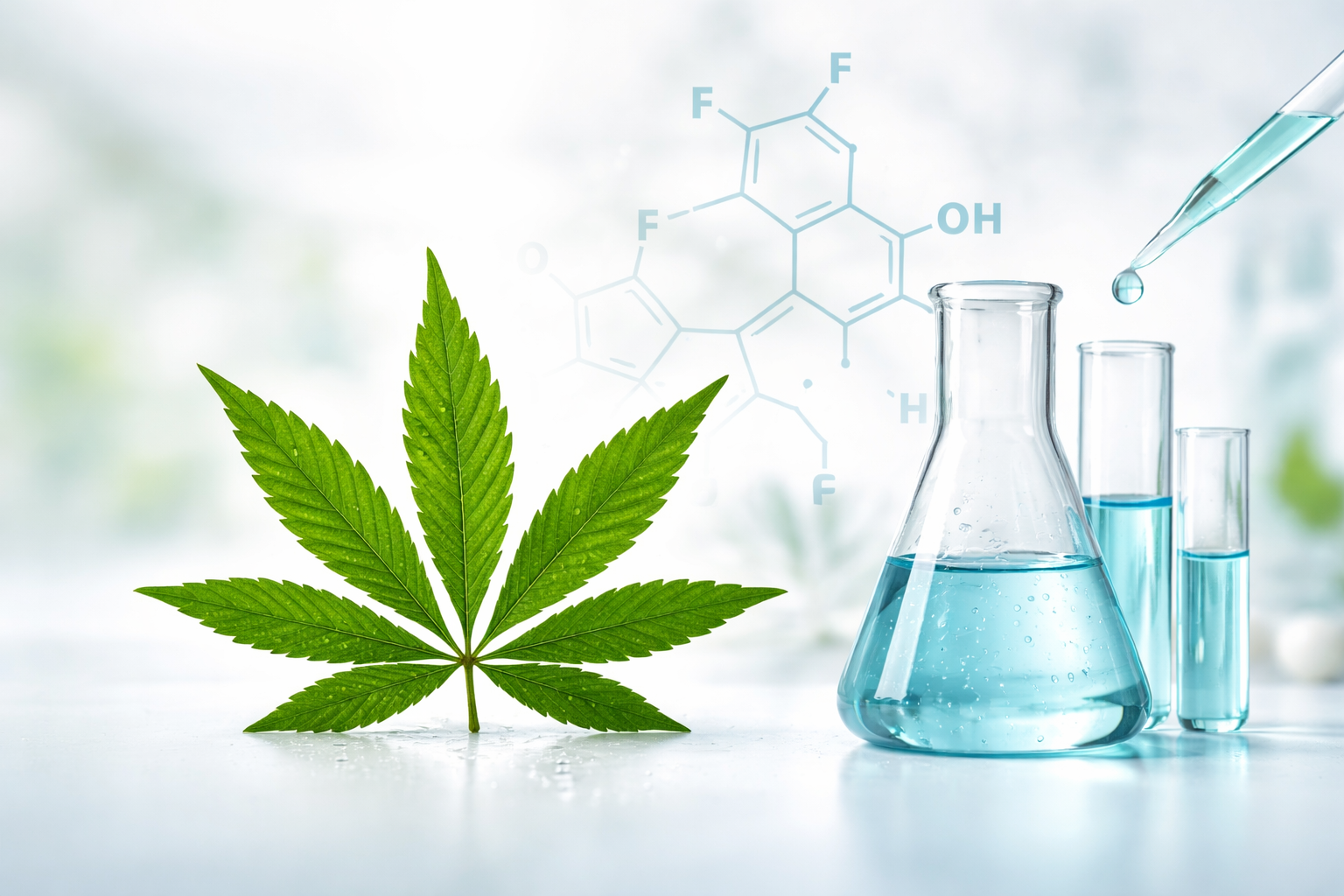 Cannabis & hemp phytoremediation: promise and pitfalls
Hemp’s ability to absorb contaminants has inspired research into using cannabis plants to remediate PFAS‑polluted soils. In Maine, the Mi’kmaq Nation and research partners received a $1.6 million EPA grant to plant hemp on a contaminated former air base and study ways to extract PFAS from harvested plants. Preliminary data showed that 10 of 28 PFAS found in the soil were detected in the harvested hemp. Scientists caution that while hemp can remove PFAS from soil, the accumulated chemicals remain in the plant, posing disposal challenges and potential risks if used for human consumption. Until researchers develop reliable PFAS degradation methods, producers should avoid cultivating cannabis for consumption on remediated land and should routinely test biomass and finished products for PFAS.
Why choose Modern Canna for PFAS testing?
- Experience with cannabis contaminants: Modern Canna has been a leader in cannabinoid, pesticide, heavy metal and microbial testing since 2014. Our laboratory understands how PFAS behave in cannabis matrices and how to minimize cross-contamination during sampling and analysis.
- Comprehensive PFAS panels: We monitor both legacy PFAS (such as PFOA and PFOS) and emerging compounds being added to the EPA’s Toxics Release Inventory. Our panels are updated as new regulations take effect.
- High-sensitivity instrumentation: Our LC‑MS/MS and GCMS systems can detect PFAS at ultra-trace concentrations, ensuring that even minor contamination is detected.
- Regulatory guidance: We stay current with evolving federal and state PFAS regulations. We can help clients interpret test results, develop compliance strategies and implement best practices for water management and cultivation.
- Quick turnaround and secure reporting: Results are delivered through our secure client portal with clear, actionable data and support for any follow‑up questions.
Related services
Looking for comprehensive contaminant screening? Modern Canna offers a full suite of testing services:
Heavy Metals Testing - detect toxic metals such as lead, cadmium, arsenic and mercury.
Pesticide & Agricultural Agents Testing - screen for pesticides, herbicides, fungicides and plant growth regulators.
Microbial Testing - identify pathogenic bacteria, molds and yeasts.
Residual Solvent Testing - ensure concentrates and extracts are free of solvent residues.
Get in touch
Protect your brand and your customers by adding PFAS testing to your compliance program. Contact Modern Canna today to discuss a customized PFAS testing plan and learn how we can support you in navigating the evolving regulatory landscape.