



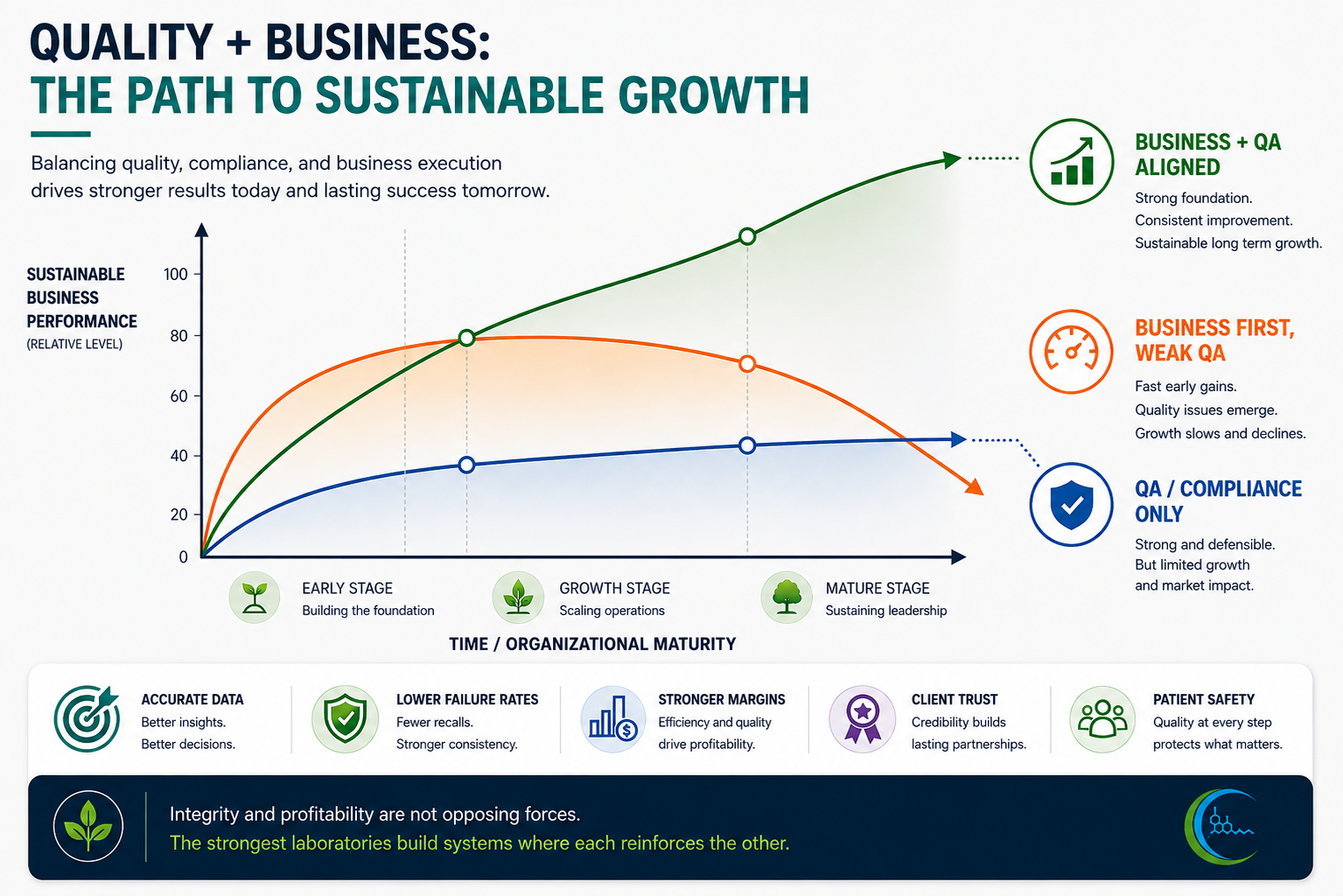
There’s a false perception in the cannabis industry that, in order to be a successful third-party testing laboratory, you have to choose between running a successful business and maintaining scientific integrity.
That gaining market share requires cutting corners. That laboratories have to provide favorable results, compromise data integrity, or bend their standards to meet client expectations.
Maybe there was a time when operating that way created a competitive advantage. And even today, there will likely always be operators looking for the laboratory that gives them the answer they want rather than the answer the data supports.
But the industry is changing.
As cannabis markets mature, regulations evolve, and operators become more sophisticated, the companies investing in strong Quality Assurance programs, better processes, better data, and higher-quality products are the ones building sustainable businesses.
Laboratories need to evolve with them.
Business, Quality and Compliance Can Work Together
There is an idea that a laboratory can’t simultaneously be commercially successful, customer-focused, scientifically rigorous, and compliant.
We believe the opposite.
Business, Quality Assurance, Science, and Compliance can work together.
Being a good business partner doesn’t mean telling a client what they want to hear. And being a good analytical laboratory doesn’t mean simply generating a COA, sending it over, and moving on to the next sample.
Our responsibility is first and foremost to provide accurate, defensible data. But the value of that data shouldn’t stop at the COA.
A great laboratory helps clients use that information to improve product quality, increase operational efficiency, identify contamination risks, avoid costly recalls, protect their reputation, and ultimately ensure patients have access to safe, high-quality products.
That’s where an analytical laboratory becomes something more valuable: a true business partner.
Quality Operations Produce Quality Results
There is another side to this conversation that often gets overlooked.
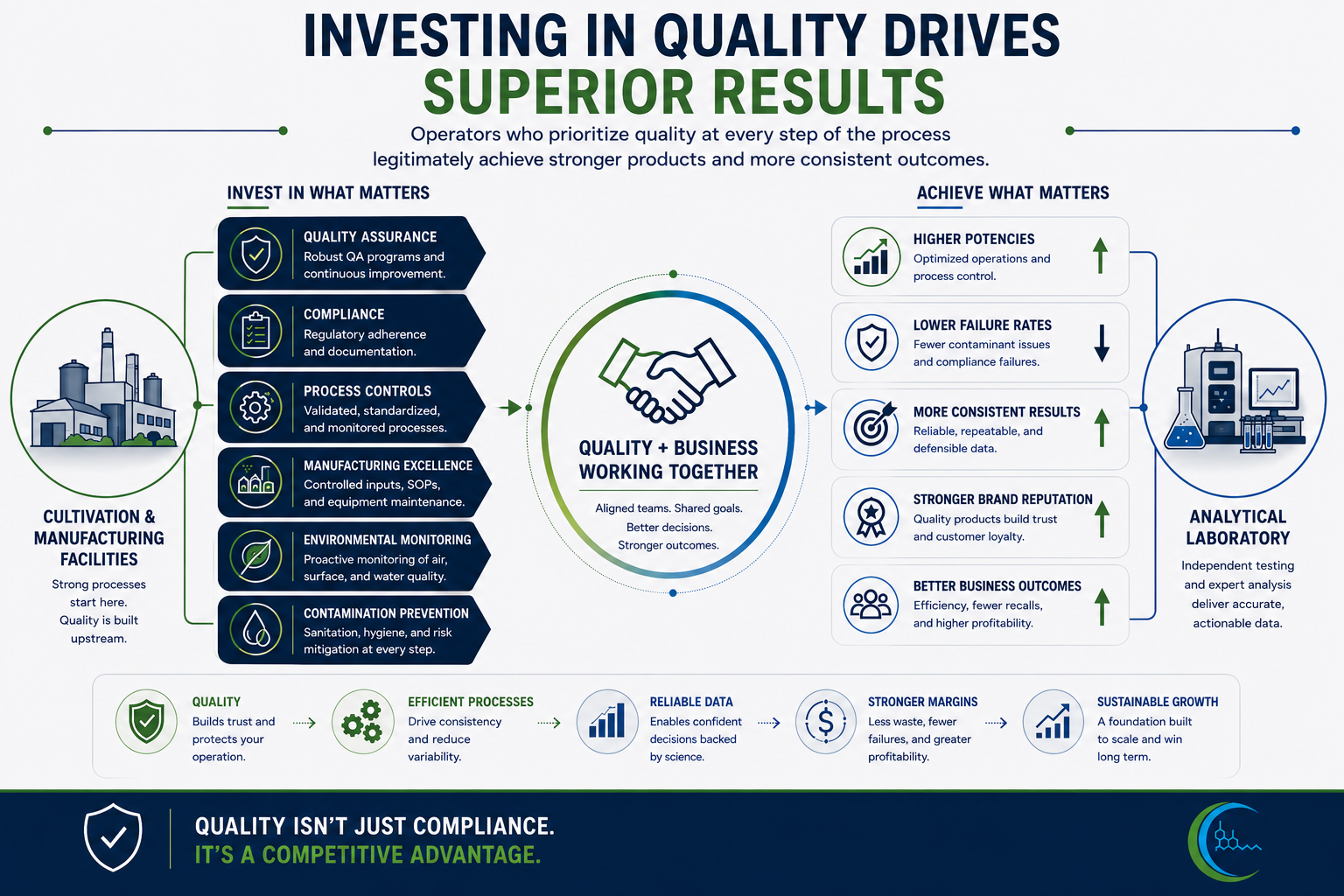
The operators that have spent years investing in Quality Assurance, compliance, cultivation controls, manufacturing processes, environmental monitoring, and contamination prevention are often the same operators that legitimately achieve higher potencies, lower failure rates, and more consistent results.
Those results aren’t being created by the laboratory. They’re the outcome of disciplined operations upstream.
When cultivators dial in genetics, environmental conditions, nutrition, and harvest timing, higher potency can be the natural result. When manufacturers control their processes and inputs, consistency improves. When organizations invest in sanitation and contamination prevention, failure rates should decrease.
That’s how the system is supposed to work.
A sophisticated, quality-driven operator doesn’t need its laboratory to manipulate data. They want accurate results because those results validate the processes they’ve worked hard to build. And when something does go wrong, they want to know about it so they can fix it.
Problems arise when an operator consistently cuts corners but still expects the analytical results of an organization that doesn’t. That can put laboratories in the uncomfortable position of feeling pressure to produce the potency numbers or passing rates necessary to retain the business.
When a high-quality operator and a high-quality laboratory work together, strong potency results and low failure rates don’t have to be suspicious. They can simply be the product of doing things the right way.
The Right People Need to Be in the Right Seats
Finding the right balance in a lab between business, science, quality, and compliance also requires the right people, particularly at the leadership level.
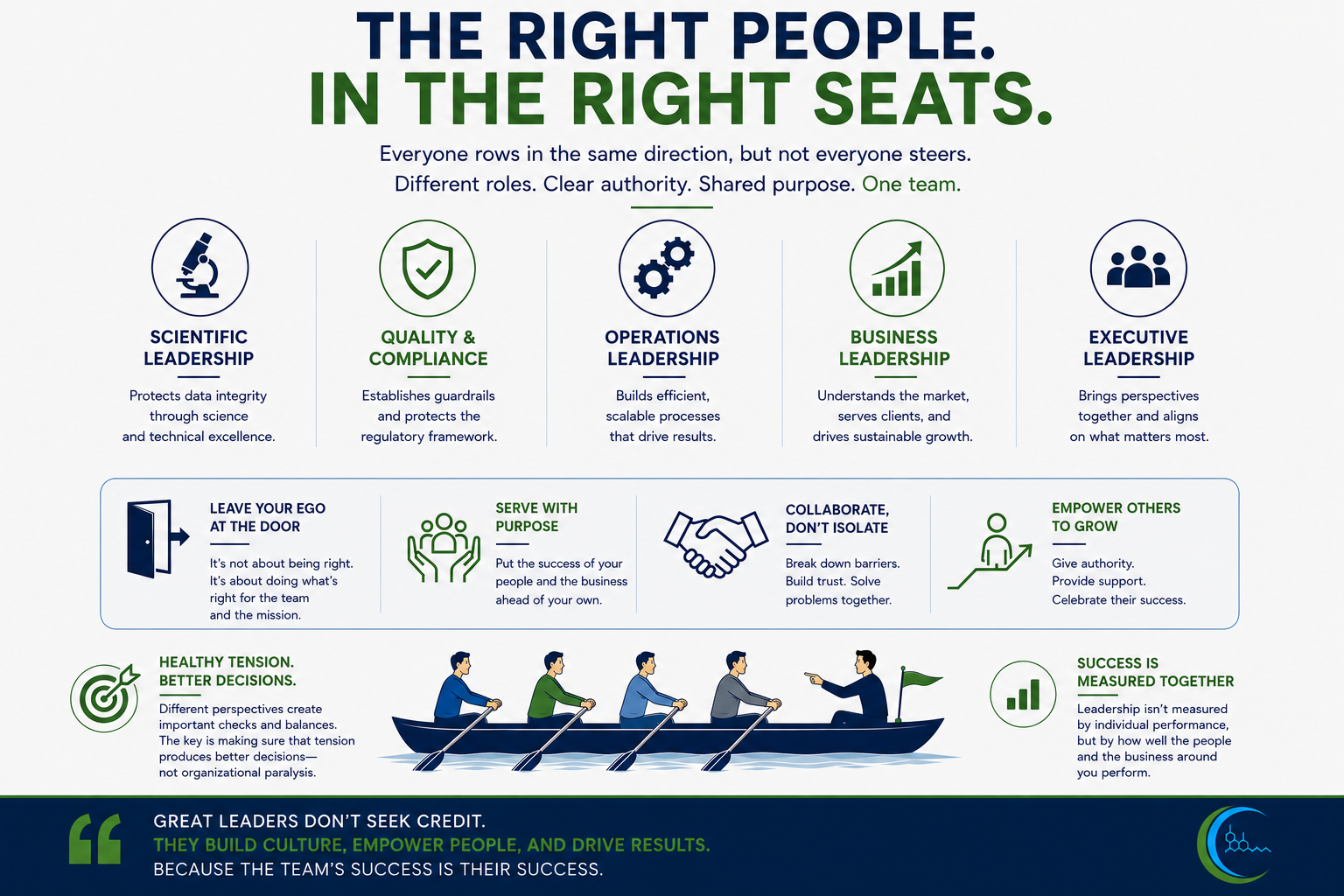
Everyone needs to be rowing in the same direction, but that doesn’t mean everyone should be making the same decisions.
A laboratory can create problems when individuals responsible for business decisions become so focused on regulatory compliance that they begin operating as an extension of the regulator rather than evaluating what is best for the business within the boundaries of those regulations.
Compliance should establish the guardrails within which the organization operates. It shouldn’t unnecessarily prevent the organization from operating, innovating, or growing.
The opposite can be equally dangerous. Business leaders shouldn’t make scientific or compliance decisions simply because a particular outcome would be commercially advantageous.
The goal isn’t for business to override compliance or for compliance to override business. Each function needs the appropriate authority to do its job effectively.
Scientific leadership protects data integrity. Quality and compliance teams protect the laboratory’s regulatory framework. Operational leaders build efficient and scalable processes. Business leaders understand the market, listen to clients, and identify opportunities for sustainable growth. Executive leadership is responsible for bringing those perspectives together.
But having the right people in the right seats goes beyond experience and technical expertise. Their motivations matter too.
The strongest leaders aren’t solely focused on their own title, authority, or professional advancement. They genuinely care about the success of their people and the organization as a whole. They develop the people around them, give them the authority to succeed, and are willing to make decisions based on what is best for the business, even when someone else gets the credit.
When leaders become overly protective of their territory, gate keeping information or begin making decisions primarily through the lens of their own professional growth, silos form and the organization suffers.
Leadership should be measured not only by individual performance, but by how well the people and the business around that leader perform.
There will always be some tension between business, science, quality, compliance, and operations. That can actually be healthy. Different perspectives create important checks and balances.
The key is making sure that tension produces better decisions rather than organizational paralysis.
When you have the right people, the right authority, and the right motivations across each function, everyone begins rowing in the same direction. That’s how you protect data integrity and compliance while still delivering exceptional service, developing your people, and building a successful business.
The Definition of a Great Lab Partner Is Changing
For years, laboratories could compete primarily on turnaround time, price, potency results, and passing rates.
Those things still matter. But sophisticated operators increasingly expect more.
The question shouldn’t simply be, “How quickly can you give me a COA?”
It should also be, “What can you help me understand about my operation?”
A modern laboratory partnership can extend across the entire production lifecycle: R&D and compliance testing, environmental monitoring, input testing, hardware testing, viroid and pathogen testing, contamination risk mitigation, leachability and stability studies, data analytics, software integrations, and cleaning and sanitation solutions.
But capabilities alone don’t make a great partner.
Customer service still matters.
How quickly does your lab respond when there’s an issue? Can your QA team communicate directly with technical directors and laboratory leadership? When you receive an unexpected result, does someone take the time to explain the data?
And when a product fails, does your laboratory simply report the failure, or does it help investigate the root cause and determine how to prevent it from happening again?
That last piece is especially important.
If an operator experiences a heavy metals, microbial, pesticide, or other failure, the COA only identifies the problem. It doesn’t necessarily explain why it happened.
Was it source water? Growing media? An agricultural input? Manufacturing equipment? Packaging? Environmental conditions? Sanitation practices?
The role of a strong laboratory partner isn’t to make a failure disappear. It’s to help the client understand why it happened and how to prevent it from happening again.
That is real value.
Data Should Drive Better Decisions
Laboratories generate enormous amounts of data, and sophisticated operators should expect that information to do more than determine whether individual samples pass or fail.
Business intelligence tools can identify trends across cultivars, facilities, product types, and production cycles. Historical data can reveal emerging contamination risks or recurring production issues.
Software integrations and automated reporting can save QA and retail teams hours of manual work while reducing the risk of human error.
A COA tells you what happened to one sample.
A strong data strategy helps you understand what’s happening across your entire operation.
The best laboratory partners also understand how their clients operate. They tailor logistics, reporting, communication, technology, and services around the systems their clients already have in place rather than forcing every organization into the same model.
That combination of science, technology, data, and customer service is where laboratory partnerships are headed.
Out With the Old, In With the New
There may always be laboratories willing to compete primarily on favorable results, unusually high potencies, or near-perfect passing rates. And there may always be operators who seek them out.
That’s not the market we are interested in competing for.
We believe the future belongs to laboratories and operators that recognize quality and profitability are not opposing forces.
The best cannabis companies will increasingly expect more from their laboratory partners: stronger science, better communication, deeper technical expertise, sophisticated technology, actionable data, and a willingness to work alongside their teams when problems arise.
The laboratories that succeed long-term won’t simply provide the numbers a client wants to see. They’ll help their clients build operations capable of producing those numbers legitimately.
Anyone can generate a result.
The best laboratories help their clients understand what that result means, what to do with it, and how to use that information to build a better business.
And ultimately, those will be the laboratories that don’t just survive as the cannabis industry matures.
They’ll be the ones helping shape what comes next.